
DASEF’s Environmental Outpost is ready to schedule your classes for exciting STEM programs! The Outpost is located at 140 Dinosaur Drive, Smyrna, Delaware 19977, just two minutes from Exit 114 on DE Route 1. Most of the programs are aligned with the DE State Science Standards, which makes them perfect for all students. Please note: Programs can be adapted to meet your curriculum needs!
To schedule a visit or outreach at your school, call the DASEF Outpost at (302) 659-5003, or contact our scheduling coordinator, Ila Jasinski, at (330) 540-1611 and ijasinski@dasef.org.
Cost per student is $7.00 for programs at the Outpost and $8.00 for Outreach to your location (plus travel cost). There is no charge for teachers and a limit of 4 adults. Each adult beyond 4 is $7.00. Due to weather and other conditions beyond our control, we may, in some instances, substitute other activities.
For Kindergarten Classes:
"Weather in Your Life" - Make a weather wheel and use it to discuss weather predictions, dress a weather bear for different weather conditions, show about the water cycle and types of weather, tour of DASEF's weather monitoring station, design a sunlight shield structure. Learn about wind and make a kite to keep.
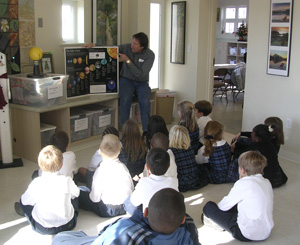
"In the Sky at Night" - Learn about Earth’s movement by looking at constellations in the StarLab planetarium.
"Forces that Push and Pull" – Explore pushing and pulling forces, including connecting movable gears, making a marble roller coaster, testing cars on ramps, and assembling a 'make-and-take' climbing creature.
For First Grade Classes:
"Predictable Patterns: Sun, Moon, and Stars" - Learn about the phases of the moon, the predictable rising and setting of the sun and the moon. In the StarLab Planetarium, learn when and why stars are visible at night, but not in the day (except for our sun), learn why there are different amounts of daylight throughout the year.
"Inside Plants and Animals" – Compare skeletons of different animals with regard to structure and function; examine parts of a tree seedling; study how seeds change as they grow; investigate variation in types of seeds of fruits and vegetables, plant and take seeds back to the classroom; study life cycle changes of butterflies and ladybugs; nature walk to study structure and adaptations of plants and trees.
"Between and Beyond Solids and Liquids" – Make a polymer called "gluep"; use seltzer rockets to see the power of gases in action. Identify properties of solids, liquids, and gases that make each unique, and learn what they all have in common.
For Second Grade Classes:
"Digging into Soil" – Examine soil samples and the water retention and filtration properties of soils; use hand lens observations of soil characteristics; make compost containers to take back to the classroom; create a "wormy" painting with soil as "paint".
"Bridges: Spanning with Strength" – Introduction to forces of tension and compression and how they function in bridge designs; small group problem-solving and construction challenge; presentation and testing of bridge designs; exploration with bridge building kits.
For Third Grade Classes:
"Climate: Weather or NOT?" - Learn the difference between climate and weather, design a solution that would reduce the impact of a weather related natural disaster, study maps to explain why climates are different in different regions of the earth.
"Attractive Science: Magnets" – Review of magnetic properties; use magnets with iron filings, paper clips, and ball bearings to view magnetic fields, predict and test strength of attraction, magnetic permeability of materials, and induced magnetism; magnetize and demagnetize nails; explore the power of repelling magnets with a 'magnetic canon'.
For Fourth Grade Classes:
"Sculpting the Earth" - Examine soil samples, model landscape on a stream table to examine erosion and human effects on land and water, identify satellite images of earth’s many different land forms.
"Motion and Design: Pinball and Roller Coasters" – Review forces and motion with short film; examine energy and gravitational force on falling objects; two group challenges: given materials and requirements, design and build a marble roller coaster and a pinball machine.
For Fifth Grade Classes:
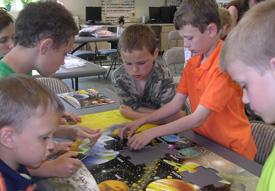
"Silent Travelers: Earth, Moon, and the Planets" – Examine satellite photos of the lunar surface, earth, and the planets; examine star 'movement', lunar phases, and our solar system in the Star Lab planetarium; design and build a lunar/planetary rover.
"Energized by the Sun" – Create a model that shows the sun as the source of the energy needed by animals to survive. Using a food web, trace the food of most animals back to plants, and show how the balance of an ecosystem can be damaged by an 'invasive' species.
For Sixth, Seventh, and Eighth Grade Classes:
"Energy and Its Effects: Producing Electricity" – Power Point slides of wind and water electricity generation in the past, present, and future; building tour and discussion of active and passive transfer of energy from solar to electric; and static and current electricity investigations.
"Investigating Force and Motion" – Record results of movement of rolling balls of varying materials; calculate and graph their speed; demonstration of the transfer of energy through simple machines; investigate simple machines as used in various tools; small group work to design a device that combines simple machines to accomplish a task.
"Investigating Near-Earth Objects" – Lunar study in StarLab planetarium including lunar phases; comparison of earth and lunar geology; Power Point presentation of physical features of planets; DVD - simulated mission to the Moon.